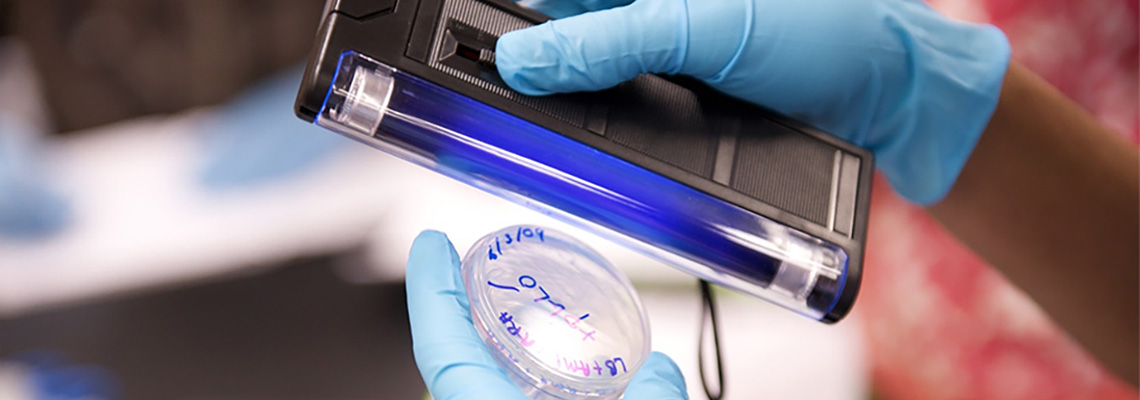
Forensic scientists are involved in all aspects of criminal cases, and the results of their work may serve either the defense or the prosecution. The forensic scientist’s goal is the evenhanded use of all available information to determine the facts and, subsequently, the truth.
By employing principles of biology, chemistry and physics to answer questions in the courtroom, forensic scientists play a pivotal role in today’s criminal justice system. They analyze evidence and provide expert opinions. A forensic scientist may consult with a medical expert about the finding of an investigation.
Transfer Options
This joint degree program allows students to first complete the A.S. degree in Science for Forensics at BMCC and then transfer to the B.S. degree program in Forensic Science at John Jay College. Students who successfully complete the A.S. degree do not have to apply for transfer admission as they are conditionally admitted to John Jay when they enroll in the program at BMCC. Additionally, BMCC has articulation agreements with Mercy College to allow you to seamlessly continue your biology education there.
Explore Careers
BMCC is committed to students’ long-term success and will help you explore professional opportunities. Undecided? No problem. The college offers Career Coach for salary and employment information, job postings and a self-discovery assessment to help students find their academic and career paths. Visit Career Express to make an appointment with a career advisor, search for jobs or sign-up for professional development activities with the Center for Career Development. Students can also visit the Office of Internships and Experiential Learning to gain real world experience in preparation for a four-year degree and beyond. These opportunities are available to help BMCC students build a foundation for future success.
Contact
Professor Nipa Deora
Program Coordinator
ndeora@bmcc.cuny.edu
Related Communities


Requirements
Science for Forensics Academic Program Maps
Required Common Core
| English Composition | 6 |
| Mathematical and Quantitative Reasoning1 | 3 |
| Life and Physical Sciences2 | 3 |
| TOTAL REQUIRED COMMON CORE | 12 |
Flexible Core3
| Creative Expression | 3 |
| Individual and Society | 3 |
| Scientific World4 | 6 |
| U.S. Experience in Its Diversity | 3 |
| World Cultures and Global Issues | 3 |
| TOTAL FLEXIBLE COMMON CORE | 18 |
| TOTAL COMMON CORE | 30 |
Curriculum Requirements
- This two-semester course acquaints students with the basic properties of living systems: metabolism, growth, responsiveness and reproduction at the cellular and organism levels as illustrated by assorted plants and animals. Two terms required.
Corequisite for BIO 210 is ENG 101 and any 100-level math course or higher, excluding MAT 150.5 and MAT 161.5
Prerequisite for BIO 220 is BIO 210 and any 100-level math course or higher, excluding MAT 150.5 and MAT 161.5
Course Syllabus - This two-semester course acquaints students with the basic properties of living systems: metabolism, growth, responsiveness and reproduction at the cellular and organism levels as illustrated by assorted plants and animals. Two terms required.
Course Syllabus - This is a two-semester course sequence that involves the study of chemical principles including atomic and molecular theories, molecular structure, and reactivity. The laboratory will include experiments illustrating the chemical principles. CHE 201-202 two terms required. Required in A.S. (Science) and A.S. (Engineering Science). Fulfills science requirement for A.A. (Liberal Arts).
Prerequisite for CHE 202 is CHE 201
Course Syllabus - This is a two-semester course sequence that involves the study of chemical principles including atomic and molecular theories, molecular structure, and reactivity. The laboratory will include experiments illustrating the chemical principles. CHE 201-202 two terms required. Required in A.S. (Science) and A.S. (Engineering Science). Fulfills science requirement for A.A. (Liberal Arts).
Prerequisite for CHE 202 is CHE 201
Course Syllabus - This is a two-semester course for students in science and engineering. Concepts of calculus are introduced and used when necessary. The lecture and laboratory exercises pertain to mechanics, fluids, heat and thermodynamics, wave motion, sound, electricity, and magnetism, geometric and physical optics, and an introduction to modern physics.
For PHY 215, Co-requisite: MAT 302
For PHY 225, Prerequisite: PHY 215 and MAT 302
NOTE: Students cannot receive credit for both PHY 210 and PHY 215, or PHY 220 and PHY 225.
Course Syllabus - This is a two-semester course for students in science and engineering. Concepts of calculus are introduced and used when necessary. The lecture and laboratory exercises pertain to mechanics, fluids, heat and thermodynamics, wave motion, sound, electricity, and magnetism, geometric and physical optics, and an introduction to modern physics.
For PHY 215, Co-requisite: MAT 302
For PHY 225, Prerequisite: PHY 215 and MAT 302
NOTE: Students cannot receive credit for both PHY 210 and PHY 215, or PHY 220 and PHY 225.
Course Syllabus
Footnotes
- Students are required to take MAT 206 or MAT 301. Students who are strong in math can take the MAT 206 test and if they pass it, they can go directly into MAT 301.
- Students are required to take CHE 230.
- No more than two courses in any discipline or interdisciplinary field can be used to satisfy Flexible Core requirements.
- Students are required to take CHE 240 and CHE 205.
- These electives can be granted by taking STEM variants in the Common Core.