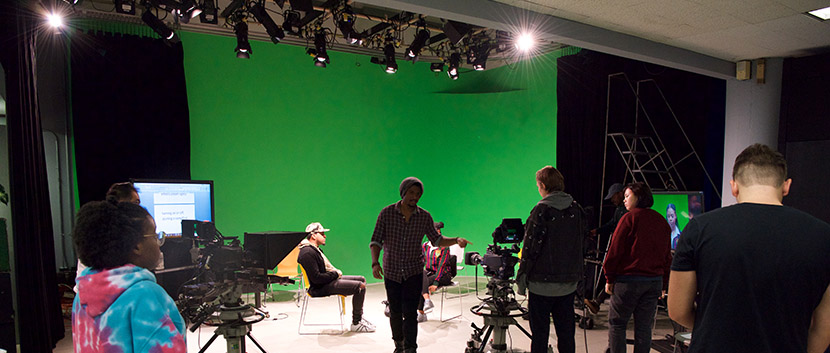
The Video Arts and Technology Program provides a dynamic education in video, audio and television production. The program will prepare you for positions in the entertainment industry, electronic journalism, audiovisual production companies, broadcast and cable networks, and corporate communications departments. There is a combination of extensive hands-on experience with theoretical coursework in a comprehensive academic program.
State of the Art TV and Audio Studios, Post-Production Labs
Video Arts and Technology students work in a digital environment in BMCC’s state of the art television studios, audio studio, and post-production laboratories.
Create Video and Audio Programs
You will learn the entire process for creating professional video and audio programs from writing a script and creating a budget, to shooting a scene and editing a final cut. All Video Arts and Technology students do an internship at a professional media facility.
Upon successful completion of the requirements listed below, you will earn an Associate in Science (A.S.) degree. Most courses in the Video Arts and Technology program (VAT courses) are restricted to students enrolled in the program.
Explore Careers
BMCC is committed to students’ long-term success and will help you explore professional opportunities. Undecided? No problem. The college offers Career Coach for salary and employment information, job postings and a self-discovery assessment to help students find their academic and career paths. Visit Career Express to make an appointment with a career advisor, search for jobs or sign-up for professional development activities with the Center for Career Development. Students can also visit the Office of Internships and Experiential Learning to gain real world experience in preparation for a four-year degree and beyond. These opportunities are available to help BMCC students build a foundation for future success.
Related Communities



This program is offered in-person, online and in a hybrid format.
Requirements
Video Arts and Technology Academic Program Maps
Required Common Core
| English Composition | 6 |
| Mathematical and Quantitative Reasoning | 3 |
| Life and Physical Sciences1 | 3 |
| TOTAL REQUIRED COMMON CORE | 12 |
Flexible Core2
| Creative Expression | 6 |
| Individual and Society | 3 |
| Scientific World3 | 3 |
| U.S. Experience in Its Diversity | 3 |
| World Cultures and Global Issues | 3 |
| TOTAL FLEXIBLE COMMON CORE | 18 |
| TOTAL COMMON CORE | 30 |
Curriculum Requirements
- This course introduces students to varied applications of contemporary media in business, entertainment, and the public sector. Students study the processes of media production, the systems for media distribution, and the roles of media professionals. The course surveys the history of modern communications and the terminology of the media industry. Students examine the complex connections between technology, content, style, and audience response in the creation of media productions.
- This course explains how video technology works and how that technology is put into practice to create video content. It covers the fundamentals of contemporary media technology including understanding video image formation, data compression, as well as picture and sound generation and manipulation. Lab exercises introduce students to the operations of cameras, video-recording systems, lighting instruments, microphones and the uses of SMPTE Time Code. Students also learn basic practical and aesthetic concepts of filmmaking by pre-producing and filming in-class exercises.
Production Courses: Choose 4 courses from:
- This course is an introduction to all aspects of basic studio television production. Students produce multi-camera TV programs in a fully equipped TV studio. Students learn to perform the functions of a director, floor manager, camera operator, audio engineer, lighting director, and technical director.
Prerequisite: VAT 100 and MES 153
Corequisite: MES 152 - This course is an introduction to the use of audio technology in theatre, television, motion pictures and multimedia. Students will be introduced to the fundamental principles of acoustics and sound recording. Tools, such as various mixing boards, microphones and recorders, will be introduced in the context of theatrical and television production. Sound design for live venues and multimedia presentations will be introduced as well. Assignments will include practical exercises. Lab assignments are required.
Prerequisite: VAT100 and MES 153
Corequisite: MES 152 - Students in this course write, produce, film, direct, and edit original projects as they learn directing and editing concepts and skills for both fiction and non-fiction digital filmmaking. Emphasis is given to post-production techniques, from basic video and audio editing to final exporting. The class is taught in a state-of-the-art digital lab using industry-standard software. This course builds upon the knowledge that students acquired in VAT 100-Introduction to Video Technology and MES 153- Script Writing, including the fundamentals of writing, directing, camera operation, lighting and sound recording.
Prerequisite: VAT 100 and MES 153
Corequisite: MES 152 - This course builds upon VAT 161 and focuses on the skills needed to successfully plan and complete a multi-camera professional studio production. Classes are conducted in a state-of-the-art, fully equipped TV studio. Students master the techniques and workflow required to produce programming according to industry standards and practices. Student work is screened, discussed and critiqued to deepen understanding of the art and craft of television. Prerequisite: VAT 161 or permission of the department
- This course concentrates on the post-production aspects of audio production. Sound effects editing, Automatic Dialogue Replacement (ADR), Foley editing and music replacement will be covered in the context of television and motion picture post-production. Mastering of recordings for distribution will also be covered. Students will be expected to work on projects using media server technology, allowing for simultaneous picture and sound editing. Collaborative projects will also be included. Lab assignments are required.
Pre-Requisite: VAT165 and MMP100 - This course builds upon VAT 171. It reinforces the skills needed to successfully plan, shoot, edit, and refine remote video productions. The course includes advanced techniques in digital cinematography, digital editing and audio and visual effects.
Pre-Requisite: VAT171 or DEPT. PERMIT
Program Elective5
Experiential Learning: Choose 1 course from MEA 201 or MEA 371:
- 2 CRS.2 HRS.NULL LAB HRS.Professional Development and Career Planning in Media Arts and Technology
- In this course students are instructed in industry appropriate methods to creatively plan their careers. Students learn about self-assessment, career exploration, and practical job search skills. In this course, students will identify the techniques used to identify target markets, negotiate with clients, apply sound business management principles, and successfully self-promote. The course includes the following topics: how to identify and classify your career needs, interests, values, and skills; researching occupational and organizational alternatives; job search techniques and resources for employment; resume and cover letter preparation; portfolio presentation; job interviewing and follow-up. Prerequisite: ANI 401 or two MMA 200-level courses or higher or two MMP 200-level courses or higher or two courses from VAT 161, VAT 165, VAT 171, VAT 261, VAT 265 or VAT 271.
- The objective of the internship is to allow the student to put classroom theory in her/his major into practice in order to gain work experience. Each student-intern is assigned to a coordinator who is knowledgeable about the student's field. The coordinator helps the student secure internship placement in a work site related to the student's major, or assists the student to "reconstruct" her/his present position as an internship, or develop "by special arrangement" an internship with her/his present employer, and serves as the student's instructor and advisor during the field experience. Over a semester the Media Arts and Technology Internship requires a total of 150 hours, including but not limited to, hours at the internship site. In this course MEA students are expected to: intern approximately 10 hours a week, complete a term project assigned by the coordinator, and be evaluated by the work site supervisor. Students to be placed are expected to arrange their schedules so that they are free mornings or afternoons, Monday - Friday, or two to three full days per week.
Prerequisite: Departmental Approval
Advised Electives6
Notes
This program has received a waiver to specify particular courses students must take in some areas of the Common Core. If students take different courses in these areas, they will be certified as having completed the Common Core areas, but it may not be possible for them to finish their degree program within the regular number of credits.
Please note, these requirements are effective the 2022-2023 catalog year. Please check your DegreeWorks account for your specific degree requirements as of when you began at BMCC will determine your program requirements.
Footnotes
- Students are required to take PHY110, or PHY400.
- No more than two courses in any discipline or interdisciplinary field can be used to satisfy Flexible Core requirements.
- Students are required to take MMP 100.
- These credits can be satisfied by taking STEM variants in the Common Core.
- Choose 1 course from any VAT 300-level or higher, OR ANI 301, OR MES 251. MES 251 cannot count as both Program and Advised Elective.
- Choose 1 course from MMA 100, MMP 270, BUS 200, HED 250, MUS 123/225, THE 110, ANI 401, COM 245, MEA 211, MEA 300 or MES 251. MES 251 cannot count as both Program and Advised Elective.